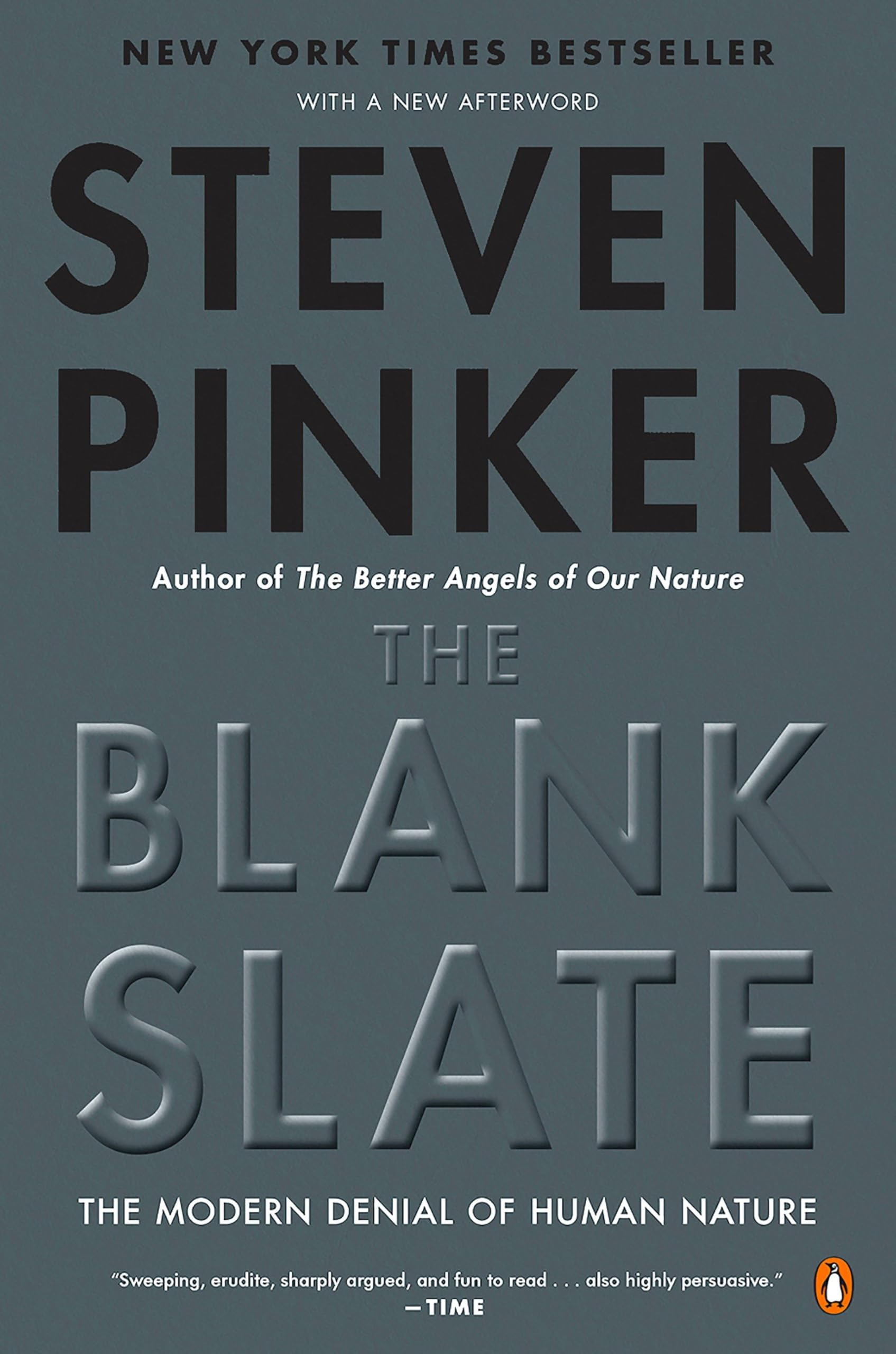
The Blank Slate: The Modern Denial of Human Nature
Product ID: 1781699
Buy anything from 5,000+ international stores. One checkout price. No surprise fees. Join 2M+ shoppers on Desertcart.
Desertcart purchases this item on your behalf and handles shipping, customs, and support to Vietnam.
The Blank Slate: The Modern Denial of Human Nature [Pinker, Steven] on desertcart.com. *FREE* shipping on qualifying offers. The Blank Slate: The Modern Denial of Human Nature Review: An important book for the modern world - Steven Pinker is a prominent member of a new cohort of science populizers with genuine scientific credentials (which includes, in the area of brain studies, such authors as Joseph LeDoux, Antonio Damasio, Daniel Dennett). His latest book is by far his most political therefore his most important. As it turns out, the data show that we have much in common as members of the human species, and the news is not all bad. In the Blank Slate, Pinker directly addresses the major ideological impediments which prevent the widespread adoption of an enlightened, scientifically valid view of humanity. People have opposed the idea of human nature, Pinker argues, due to the adherence to three ideas: the Blank Slate, the Noble Savage, and the Ghost in the Machine. After presenting empirical and philosophical arguments against this trio of ideas, Pinker turns to directly addressing the fears accompany the denial of human nature. Specifically, people fear that human nature bolsters the acceptance of inequality (and hence injustice) and prevents progress and perfectability of people and society. Pinker counters that such fears are founded upon an exaggerated and overly simplistic view of the manner in which our genes influence our thoughts and actions. Such influences always remain beneath our consciousness and volition; they are one of the ultimate causes of our behavior, but never the sole cause or the immediate cause. This relates to another major fear: the fear of biological determinism, the absence of free will. Pinker also discusses the fear of nihilism, the fear that once our actions and preferences are understood to be rooted in biology, our lives will loose meaning and morality. Again, Pinker shows that such fears are founded upon misunderstanding and oversimplification, as well as the confusion between ultimate casues and mechanism, on the one hand, and the immediate and proximate causes on the other. In general, many progressives on the political Left have embraced the Blank Slate and the Noble Savage to provide the foundation for ideologies of cultural transformation and reform, in the service of redressing injustices and inequalities. Unfortunately, as Pinker demonstrates, the evidence (as well as our own common sense experiences) indicates that we are neither Blank Slates or Noble Savages. The sum total of our inherited tendencies, our human nature, is neither wicked or noble. Nonetheless, there is the fear, found on both the political Left and Right, that embracing human nature also means normalizing and sanctioning the unseamly side of ourselves. But, as Pinker argues, "natural" is an empirical judgement; "good" is a moral one. Some critics have argued that no one really believes in the Blank Slate any more, and that Pinker is fighting "straw men." I think, however, that Pinker does a good job of showing that Blank Slate positions are often the implicit default in matters of public discussion and policy making; Blank Slate ideas continue to misguide efforts, even when the Blank Slate is not intentionally invoked. The third notion which Pinker disputes, the Ghost in the Machine, is far more important to people committed to the political Right, because the Ghost is frequently equated with the immaterial spiritual soul. The major implication of modern neuroscience has been that the workings of the human mind can be adequately explained by the workings of the human brain, as Pinker has shown in more detail in his previous book, How the Mind Works. The more we learn about brain function, the more it has taken over the job description previously assigned to the soul or to the Ghost. The Ghost remains in the mind of many as the only possible foundation for Free Will, and hence meaning and morality. Free will and an inherited human nature are not necessarily contradictory, however, as long as one avoids a simplistic biological determinism in which genes directly control our actions and opinions. In place of all these fears, Pinker constructs an empirically-supported view of our human nature, addressing in turn 1) the reliabilty and veracity of our perception and our understanding of the world; 2) the sources of interpersonal conflict as well as the sources of a realistic (non-supernatural) morality; 3) the hot-buton topics of race, gender, violence, and child rearing. This is were some of the real meat, the empirical data, is to be found; and this is where Pinker makes good on his claims that accepting the idea of human nature is neither dangerously reactionary or bebasing. An acquaintance of mine wondered just who this book was intended for, since it appeared to be written above the level of your average person. So be it: Science can be popularized by good writing and clear thinking, but it cannot be greatly simplified without significant loss of coherence and cogency. The book is intended for us: for whoever has the motivation to pick it up or to read this review. If you've read this far, do yourself a favor and read Pinker's book. It's not only fascinating and well-argued; it's important. Review: An essay rather than a dogma - Mr. Pinker tries to start a reflexion on what makes us what we are. This book is more a synthesis of his ideas than a scientific work. It gives occasions to question what we believe to be obvious, while it is only the result of the mainstream idea which has been invading the medias and the families for decades : the idea that the human mind is a mere "blank slate" and that, subsequently, all our behaviours, and more generally, our plagues, come from our environment, ie, family, "society" or "culture". I agree that Mr. Pinker sometimes simplifies his opponents' viewpoints, and he sometimes lacks of nuance and in-depth analysis. But I don't think he ever pretended to release a scientific work. I think that, first of all, Mr. Pinker wants us to change our references and to be able to accept the very idea of an open debate on the human nature. I personally loved changing my mind on so many topics, or at least finding out that other approaches were possible, where I used to be entrenched in a one-explanation approach. For instance I used to believe that parenting was the alpha and omega of what makes a person what she/he is. Steven Pinker's book ruined this certainty. I am happy I ceased accusing my parents of all my difficulties in life. This by no means implies that parenting is not a good and important thing. It only gives an opportunity to change glasses about what it means to be a mother or a father. There are dozens of other fascinating examples of what "the Blank Slate" can bring to the reader. Maybe this explains the violence behind the debates about human nature. The book invites us to ask ourselves about our ability to question our certainties with GOOD FAITH, i.e., our ability to admit that facts could invalidate sometiles (but not all the times) our opinions. Even if we are not forced to follow Mr. Pinker in ALL his developments (I don't say I do), it is still an interesting approach, which brings lots of factual, solid information often ignored by most of us. It is a good start for reflexion, and by no means a dogmatic or "reductionnist" work (I always wonder why this word, "reductionnist" is used by people who precisely reduce the whole human experience to social and familial patterns and reject any other approach). Some of the reviews here on desertcart.com come from people who visibly have difficulties dealing with FACTS and are really very aggressive (hence my 5 stars, in order to compensate such undue attacks). When FACTS tend to question our opinions, we have two choices : 1. We admit that we could be wrong and try to start a discussion to redefine our point of view; or 2. We attack the man who states these facts and pretend him to be a stupid / fascist / chauvinist person. I don't say I always fall in the first category, but I think it is a good way to discuss books like Mr. Pinker's (instead of personal and aggressive attacks, or, worse, commentaries written by people who didn't read the book since they reproach to Mr. Pinker ideas that he never expresses). It is true that Mr. Pinker sometimes adopts a biased presentation of facts. But the nice thing is that he quotes all his references and exposes every step of his reasoning, which allows a true discussion and an open, honest debate. I really enjoyed very much reading this book.
| Best Sellers Rank | #76,666 in Books ( See Top 100 in Books ) #8 in Evolutionary Psychology (Books) #80 in Popular Psychology Personality Study #217 in History & Philosophy of Science (Books) |
| Customer Reviews | 4.6 out of 5 stars 1,909 Reviews |
M**T
An important book for the modern world
Steven Pinker is a prominent member of a new cohort of science populizers with genuine scientific credentials (which includes, in the area of brain studies, such authors as Joseph LeDoux, Antonio Damasio, Daniel Dennett). His latest book is by far his most political therefore his most important. As it turns out, the data show that we have much in common as members of the human species, and the news is not all bad. In the Blank Slate, Pinker directly addresses the major ideological impediments which prevent the widespread adoption of an enlightened, scientifically valid view of humanity. People have opposed the idea of human nature, Pinker argues, due to the adherence to three ideas: the Blank Slate, the Noble Savage, and the Ghost in the Machine. After presenting empirical and philosophical arguments against this trio of ideas, Pinker turns to directly addressing the fears accompany the denial of human nature. Specifically, people fear that human nature bolsters the acceptance of inequality (and hence injustice) and prevents progress and perfectability of people and society. Pinker counters that such fears are founded upon an exaggerated and overly simplistic view of the manner in which our genes influence our thoughts and actions. Such influences always remain beneath our consciousness and volition; they are one of the ultimate causes of our behavior, but never the sole cause or the immediate cause. This relates to another major fear: the fear of biological determinism, the absence of free will. Pinker also discusses the fear of nihilism, the fear that once our actions and preferences are understood to be rooted in biology, our lives will loose meaning and morality. Again, Pinker shows that such fears are founded upon misunderstanding and oversimplification, as well as the confusion between ultimate casues and mechanism, on the one hand, and the immediate and proximate causes on the other. In general, many progressives on the political Left have embraced the Blank Slate and the Noble Savage to provide the foundation for ideologies of cultural transformation and reform, in the service of redressing injustices and inequalities. Unfortunately, as Pinker demonstrates, the evidence (as well as our own common sense experiences) indicates that we are neither Blank Slates or Noble Savages. The sum total of our inherited tendencies, our human nature, is neither wicked or noble. Nonetheless, there is the fear, found on both the political Left and Right, that embracing human nature also means normalizing and sanctioning the unseamly side of ourselves. But, as Pinker argues, "natural" is an empirical judgement; "good" is a moral one. Some critics have argued that no one really believes in the Blank Slate any more, and that Pinker is fighting "straw men." I think, however, that Pinker does a good job of showing that Blank Slate positions are often the implicit default in matters of public discussion and policy making; Blank Slate ideas continue to misguide efforts, even when the Blank Slate is not intentionally invoked. The third notion which Pinker disputes, the Ghost in the Machine, is far more important to people committed to the political Right, because the Ghost is frequently equated with the immaterial spiritual soul. The major implication of modern neuroscience has been that the workings of the human mind can be adequately explained by the workings of the human brain, as Pinker has shown in more detail in his previous book, How the Mind Works. The more we learn about brain function, the more it has taken over the job description previously assigned to the soul or to the Ghost. The Ghost remains in the mind of many as the only possible foundation for Free Will, and hence meaning and morality. Free will and an inherited human nature are not necessarily contradictory, however, as long as one avoids a simplistic biological determinism in which genes directly control our actions and opinions. In place of all these fears, Pinker constructs an empirically-supported view of our human nature, addressing in turn 1) the reliabilty and veracity of our perception and our understanding of the world; 2) the sources of interpersonal conflict as well as the sources of a realistic (non-supernatural) morality; 3) the hot-buton topics of race, gender, violence, and child rearing. This is were some of the real meat, the empirical data, is to be found; and this is where Pinker makes good on his claims that accepting the idea of human nature is neither dangerously reactionary or bebasing. An acquaintance of mine wondered just who this book was intended for, since it appeared to be written above the level of your average person. So be it: Science can be popularized by good writing and clear thinking, but it cannot be greatly simplified without significant loss of coherence and cogency. The book is intended for us: for whoever has the motivation to pick it up or to read this review. If you've read this far, do yourself a favor and read Pinker's book. It's not only fascinating and well-argued; it's important.
B**D
An essay rather than a dogma
Mr. Pinker tries to start a reflexion on what makes us what we are. This book is more a synthesis of his ideas than a scientific work. It gives occasions to question what we believe to be obvious, while it is only the result of the mainstream idea which has been invading the medias and the families for decades : the idea that the human mind is a mere "blank slate" and that, subsequently, all our behaviours, and more generally, our plagues, come from our environment, ie, family, "society" or "culture". I agree that Mr. Pinker sometimes simplifies his opponents' viewpoints, and he sometimes lacks of nuance and in-depth analysis. But I don't think he ever pretended to release a scientific work. I think that, first of all, Mr. Pinker wants us to change our references and to be able to accept the very idea of an open debate on the human nature. I personally loved changing my mind on so many topics, or at least finding out that other approaches were possible, where I used to be entrenched in a one-explanation approach. For instance I used to believe that parenting was the alpha and omega of what makes a person what she/he is. Steven Pinker's book ruined this certainty. I am happy I ceased accusing my parents of all my difficulties in life. This by no means implies that parenting is not a good and important thing. It only gives an opportunity to change glasses about what it means to be a mother or a father. There are dozens of other fascinating examples of what "the Blank Slate" can bring to the reader. Maybe this explains the violence behind the debates about human nature. The book invites us to ask ourselves about our ability to question our certainties with GOOD FAITH, i.e., our ability to admit that facts could invalidate sometiles (but not all the times) our opinions. Even if we are not forced to follow Mr. Pinker in ALL his developments (I don't say I do), it is still an interesting approach, which brings lots of factual, solid information often ignored by most of us. It is a good start for reflexion, and by no means a dogmatic or "reductionnist" work (I always wonder why this word, "reductionnist" is used by people who precisely reduce the whole human experience to social and familial patterns and reject any other approach). Some of the reviews here on Amazon.com come from people who visibly have difficulties dealing with FACTS and are really very aggressive (hence my 5 stars, in order to compensate such undue attacks). When FACTS tend to question our opinions, we have two choices : 1. We admit that we could be wrong and try to start a discussion to redefine our point of view; or 2. We attack the man who states these facts and pretend him to be a stupid / fascist / chauvinist person. I don't say I always fall in the first category, but I think it is a good way to discuss books like Mr. Pinker's (instead of personal and aggressive attacks, or, worse, commentaries written by people who didn't read the book since they reproach to Mr. Pinker ideas that he never expresses). It is true that Mr. Pinker sometimes adopts a biased presentation of facts. But the nice thing is that he quotes all his references and exposes every step of his reasoning, which allows a true discussion and an open, honest debate. I really enjoyed very much reading this book.
B**S
Gould, his troika, and followers deserve credit for the monster they helped create on the Right
This book is about science and politics. Pinker took on the project this book represents after colleagues told him that little boys are aggressive because they’re socialized to be, teenagers get the idea to compete for appearance thanks to spelling bee awards, and men think sex is desirable because society tells them it is. In other words, humans are born a blank slate, only nurture, not nature, will make them what they are. “This is the mentality of a cult,” writes Pinker, “in which fantastical beliefs are flaunted as proof of one’s piety. This mentality cannot exist with an esteem for truth… [and is] responsible for unfortunate trends… [like] a stated contempt among many scholars for the concepts of truth, logic, and evidence, and the inevitable reaction [of] politically incorrect shock jocks who revel in anti-intellectualism and bigotry, emboldened by the knowledge that the intellectual establishment has forfeited claims of credibility…” Amen to that! Pinker shows the cult fearful of findings from cognitive science, neuroscience, behavioral genetics, and evolutionary physiology. Why? Because they make the errant assumption that pre-wired humans are incapable of being made moral and humane. Their interpretation of statistics was as certainty, not probability. Hence, what we’re now so familiar with from the Right were long before practiced by the Left. Scientific findings were not only denied and vilified, but scientists who dare desecrate the creed were attacked with smear campaigns, character assassination, and words put in their mouth only to pronounce how wrong they were. Even the likes of paleontologist Steven J. Gould (stunned me), geneticist Richard Lewontin (naturally), and the neuroscientist Steven Rose (daft) were dupes for the movement. This troika and the campus snowflakes they inspired labeled E.O. Wilson, Richard Dawkins, and Robert Trivers as genocidal bigots, racists, practitioners of eugenics, Nazis (yawn), and Right-wing prophets of patriarchy (more yawn). All because Wilson et. al. found biology responsible for much of human behavior. (Was this really a surprise?) While Pinker’s focus is social “science” doctrine, not the shock jocks he refers to (Rush Limbaugh etc.), as one reads this book it becomes apparent there’s no difference between the two, other than what they proclaim as sacrosanct and blasphemy. After a history of the blank slate starting with John Locke, followed by the Great Schism and what the cult is trying to protect, Pinker dives into measurement, data, and reason. The identical twin studies were so pronounced and ironclad, I had to reread them, then check references to believe these clones (which is what twins are) could be so identical in their behavior. That is, twins separated at birth, shipped off to different countries, class structures, learning environments, never to know the other or their common parents, found decades later to have the same behaviors in a myriad of the most nuanced and peculiar ways. Biology matters. So it is, with the purifying flames of science separated from politically correct programs of pseudo-morality, Pinker burns just about every quasi-religious Postmodernist liberal dogma in the blank slate arena you can name—with the exception of gender-fluidity, not yet concocted. I hope one day he’ll do the same to Creationists and global warming deniers on the Right. What a thrill, and a shame to find even biologists themselves got caught up in the PC creed of our times. It also clarified for me what almost cannot be done in physics and chemistry (except for transparent liars like Ivar Giaever). Biology, several steps up from the closest thing we’ve got to certainty in the foundations of reality, allows for some fiddle-faddle and hoodwink, so long as the promoter has a notable name like Gould. Limbaugh and Creationists love this. Gould, the troika, and their followers deserve their share of credit for the monster they helped create on the Right as a response to this kind of nonsense.
M**I
Nature vs. nurture case closed--with reservations
Sociobiology is a controversial, yet important and growing field of scientific exploration. No other field of science elicits as much condemnation from academics and intellectuals, yet no other scientific endeavor has ever cast as much light on the truth about the evolution of human nature. The reason for the distain shown by academic intellectuals is sociobiology's crushing refutation of the concept known as the "blank slate" theory of human nature, which has become the cornerstone of postmodernist ideals of political correctness. The entire edifice of the postmodern human engineering project carried on at many universities and in the popular media is based upon the concept that "everything is political", and that the attribute we call "human nature" is nothing more than cultural propaganda instilled into children by their parents and reinforced throughout their lives by a rigid, chauvinistic propaganda machine that has become known as "Western Civilization". Evidence is fast mounting that human nature is anything but nonexistent, sociobiology is the area of science where this evidence is researched and proven, and Steven Pinker has done a good job of organizing and, with some reservations, elucidating the evidence. In short, boys and girls are no more identical above the neck than they are below, and every personal psychological attribute is nearly as genetically heritable as every physical attribute. This book proves to my satisfaction that human nature is a factor in the human condition, and that the blank slate theory of personality is a politically correct joke. This is a long book, a bit tedious in places, but well written, interesting and even humorous overall. The inference that genetic influences are the all-important factor in life outcome is, I think, patently false and contradicted by experience and common sense. The best possible proof of this is contained in a short, fascinating book written by Theodore Dalrymple called "Life at the bottom", which I would strongly recommend as a reality-check by which to measure some of the tenants of sociobiology presented in Pinker's book. This is especially useful when evaluating chapter 19 on the debate about nature/nurture as it concerns children. Dalrymple's book is a collection of anecdotes gleaned from the experiences of a physician who has spent his life ministering to the British underclass. He does not discredit sociobiology, a subject which is never mentioned in his book. He illuminates the subject in the light of harsh reality. In spite of its deficiencies, however, sociobiology goes a long way toward explaining how genetic tendencies coalesce into the characteristics known as "human nature". It also casts light upon the reasons that 20th century attempts to engineer utopian societies culminated in failure (and in the case of Marxist projects, the deaths of as many as a hundred million people). Sociobiology is, however explicitly silent upon the subject of how best to contain these human impulses in order to establish and maintain an orderly, yet progressive and free civilization. The "fact" of Human Nature presents us with a slew of "natural" behaviors. On the other hand, just because a behavior may be natural does not necessarily mean that its uninhibited expression is appropriate for the maintenance of an orderly civilization and a happy life. While evidence from sociobiology seems to refute some of the cherished beliefs of modern conservatism as well as liberalism, the case against liberalism is much stronger. Pinker works very hard to establish his credentials as a modern liberal throughout the book, and in some areas I believe that his desire to be seen as a liberal has colored the conclusions he draws from his evidence. This is definitely a worthwhile book. Take the evidence seriously, but be wary when navigating the shoals of the author's opinions.
C**G
Consciousness raising book with a small agenda
Have you ever read a book that completely changes the way you view the world? The author demolishes many things held dear to us, but he is able to lucidly turn this seemingly stark world-view around and reveal its promise and elucidates the inherent dangers of the old world-view. That is a rare talent! In reading the book, I was constantly made uncomfortable by some of the findings he discusses, but in the end I felt that this new vision was inspiring and extremely intuitive. The author begins with a discussion of how the mind works and discusses the field of evolutionary psychology before he begins a tour-de-force, discussing everything from gender to politics to violence. In these discussions, the author misses on a few points, where it appears he almost has an agenda, but most of the discussion is reasoned, rational and even-handed. Many of the authors faults are as a result of the crime of omission where his focus is directed towards his decidedly libertarian political bias. In particular, I ended up reading the chapter on politics and while agreeing with him on his bashing of some liberal pre-conceived notions, I came to a different conclusion than the author. When he starts discussing free markets and rational actors, he tends to lose me. When he mentions that irregardless of social programs to create a level playing field, some people will still be left behind, doesn't mean that these programs don't help some people. The author takes great pains to lucidly show that there are no differences in IQ among races, but how does he couple this with the fact that black people are more likely to be criminals, less likely to go to school and more likely to be poor. Irregardless of a blank slate, there are a lot of societal shaping factors at play, which can be rectified social programs. But overall, this book is right on the spot, clear-headed and rational. The chapter on "suffering" is amazingly powerful, poetic and inspiring. I found myself highlighting my copy every sentence in this chapter. The author provides an honest dissection of why we should treat people equally as a universal moral idiom, rather than based on genetically-imbued talents, skills and intelligence. The author discusses the honest fact, that men and women are inherently different, on average but our policies shouldn't discriminate because there is a great inherent overlap. In conclusion, this book provides a cogent analysis of human nature that while seemingly alien, upon introspection is an entirely intuitive analysis of our human condition. This is an essential read that is mind-expanding as well as emotionally satisfying.
B**K
A Human Review, Naturally
The Blank Slate: The Modern Denial of Human Nature by Steven Pinker The Blank Slate is an ambitious book that goes after the blank slate fallacy that is the idea that the human mind has no inherent structure and can be inscribed at will by society or ourselves. It's a social-biological study of nature versus nature. This excellent 528 page-book is composed of the following six parts: Part I. The Blank Slate, the Noble Savage, and the Ghost in the Machine, Part II. Fear and Loathing, Part III. Human Nature with a Human Face, Part IV. Know Thyself, Part V. Hot Buttons, and Part VI. The Voice of the Species. Positives: 1. Steven Pinker the well known Professor of Psychology at Harvard University writes thought-provoking, well-researched books and this book is no different. 2. Professor Pinker goes after the doctrines of the Blank Slate, the Noble Savage, and the Ghost in the Machine and does so with gusto and a mountain of scientific evidence. 3. I'm glad someone finally refers to Social Darwinism to what it really is, "Social Spencerism". 4. The fallacy of behaviorists. 5. The theory of mind explained. 6. Great quotes with conviction. "The evidence is overwhelming that every aspect of our mental lives depends entirely on physiological events in the tissues of the brain". 7. The three great outrages of self-love. 8. How genes affect our behavior..."Small differences in the genes can lead to large differences in behavior". 9. Evolution is central to the understanding of life. 10. Culture defined. 11. Fascinating look at how our brains remain active during "assembly". 12. Evolutionary biology used to explain the complex cognitive and behavioral adaptations. 13. The attacks on "determinism" and "reductionism". 14. The religious opposition to evolution and its intended corruption of American science education. 15. The religious opposition to neuroscience. The exorcism of the human soul. I would love a whole book on just this topic! 16. The dangerous fallacy of equating evolutionary psychology with "Social Darwinism". 17. Debunking the four fears over the anxiety of human nature. 18. The fact that all species harbor genetic variability, but our species is among the less variable ones. Racial differences being among them. 19. The disposal of eugenics, discrimination, and Social Darwinism. 20. Many excellent messages throughout the book, "An idea is not false or evil because the Nazis misused it". 21. The fallacies of Nazism and Marxism. Nazism with races and the Marxists with classes. 22. Homosexuality in its proper form. 23. The importance of respecting women's fundamental rights to their bodies. 24. The compatibility of human nature with social and moral progress. Excellent! 25. The debunking of environmental determinism. 26. How our minds work. 27. The fallacy of the soul! 28. The co-evolution of intelligence and language. 29. The importance of our genes. 30. The ethics of autonomy, community and divinity explained. 31. Tragic Vision and Utopian outlooks. 32. Interesting take on the goals of the Constitution. How to anticipate and limit that corruption became an obsession of the framers. 33. Interesting take on economics. 34. Fascinating look at the fallacy of the connection between media violence and violent behavior. 35. The logic of violence. 36. The understanding of true equality. 37. Gender under a true light. 38. The appalling notion that rape has nothing to do with rape. Thank you. 39. The three laws of behavioral genetics. 40. Many parenting myths debunked, bravo! 41. A good grasp of how the mind works is indispensable to the arts. 42. Great notes. 43. Extensive references. Negatives: 1. Links did not work. A real crime for a book like this. 2. Not an even-handed approach. Mr. Pinker has his opinions and does not hesitate to use them. This could be considered a positive but it's not because the author does unleash ad hominen attacks to some of his opponents. For example, B.F. Skinner. 3. The book could be tedious to read at times. 4. It requires an investment of time. The book is too long. 5. A more comprehensive summary at end of each chapter would have been added value. In summary, this is an important contribution to knowledge. This book is worthy of five stars just based on the wisdom you will obtain. Many important ideas and thoughts are found throughout this ambitious book. Such as, that new ideas from the sciences of human nature DO NOT undermine human values. Further suggestions: "Human" by Michael S. Gazzaniga, "SuperSense" by Bruce M. Hood, "The Myth of Free Will" by Cris Evatt, "Hardwired Behavior" by Laurence Tancredi, "Braintrust: What Neuroscience Tells Us about Morality" by Patricia S. Churchland, and "The Brain and the Meaning of Life" by Paul Thagard.
U**L
A work of cultural commentary informed by science, not a work of science itself.
Note that this is more of a commentary than a review - this book needs it! Pinker's other books were more fun to read, because they were about cognitive science and linguistics. This book is very verbose and seems self-indulgent at times, but he gets his points about culture very clearly. Pinker tries to inform social sciences in this book, rightfully so, but he often seems to break out into tangents. I feel the book could be divided into many different parts given the scope of ideas he wanted to deal with, and some parts could have been removed without any loss to his argument. Many of the things he may mention may seem trivial to the informed reader, but they were novel when the book was written. The central idea of his book is about the three main ideas present in the History of Western Philosophy and ingrained in public and academic consciousness: The Noble Savage (`we are born noble, but corrupted by society') , The Blank Slate (`tabula rasa' - we are born without any innate mechanisms and the blank is filled by experience) and The Ghost in the Machine (`we are guided by a spirit and our thoughts are not a product of our nervous system'). Pinker wants to use evolutionary theory as a base for the idea of innateness and advocates for a paradigm shift away from thinking of humans as only learning through experience. We are made witness to a beautiful demolition of the concept of political correctness or the phenomenon of moral outrage based on faulty logic when it comes to evolutionary psychology. This is based on moral self-gratification and an ill-informed fear of the post-Nazi phobia of commentary regarding genetic bases of behaviour. No one likes biological determinism, some parts can be scary, but you can't afford to close your eyes to statistical results that show that intelligence and some positive traits are hereditary. He points out this hypocrisy beautifully, and I'll quote it again in it's elegant form "I find it truly surreal to read academics denying the existence of intelligence. Academics are OBSESSED with intelligence. They discuss it endlessly in considering student admissions, in hiring faculty and staff, and especially in their gossip about one another". Following into the normal traps of academic life, Pinker's avoidance of the silly liberal bias of academics that equality is natural is avoided ("political equality is a moral stance, not an empirical hypothesis"). Pinker writes about nature from his natural habitat of linguistics and Chomsky's idea of language "growth" as opposed to "learning." The mind is reduced to its prewired computational functions. The Ifaluk tribe has an emotion called 'song' ("state of dudgeon triggered by a moral infraction") analogous to the Western emotion of 'anger'. Pinker feels that language is based on observable behaviour, but both emotions may arise from the same brain functions endowed by our evolutionary history. He puts it very aptly, "Universal mental mechanisms can underlie superficial variation across cultures". The book itself provides an introduction to evolutionary psychology, in fact, that is mainly what the book is about. You'll hear about all the normal controversial topics: the nature of altruism, aggression, child rearing and game theory. Some of his arguments are strong, others are very weak. For example, his claim that the idea of the Blank Slate is not feasible because "if our minds were malleable they would be easily manipulated by our rivals, who would mould or condition us into serving their needs rather than our own. A malleable mind would quickly be selected out". This is a hard claim to verify through empirical evidence, and it seems more like a convenient narrative than scientific fact. The real juice of the book comes when he discusses the behavioural roots of human conformity and imitation. He explains conformity as the information taken from others can help survival. Moreover, normative motives allow people to assimilate into a society by settling on a `cooperative equilibria' (money, public goods etc.) that allow for group survival. His ideas on culture are interesting to say the least: culture seems abstract and to transcend biology (not literally, thats ridiculous). He gives the perfect instance, take the sentence "English has a larger vocabulary than Japanese" could be true even if no individual English speaker has a larger vocabulary then a single Japanese speaker. "English language was shaped by broad historical events that did not take place inside a single head... at the same time, none of these forces can be understood without taking into account the thought processes of flesh-and-blood people". This is the perfect one-line justification for why psychology and biology have the license to comment about culture, breaking into the exclusive hold of the humanities. Yes, scientific analysis of culture may be nerdy and back-fitted, but science aims to fund truths, not necessarily ones that are interesting from every angle. His moral discussions are also brilliant: since our behaviours arise from our primitive hunter-gatherer roots, what does that mean for us in our modern society: "So if we are put in this world to rise above nature, how do we do it?" This is where his ideas of proximate (causes of real-time behaviour e.g. hunger, lust) and ultimate cause (the adaptive rationale that led to the proximate cause to evolve - hunger for nutrition, lust for reproduction) come in. A good third of the book that talks about genes and evolutionary psychology is better captured in a more straightforward and less verbose style by Gary Marcus in ` The Birth of the Mind: How a Tiny Number of Genes Creates The Complexities of Human Thought ' that I reviewed earlier. It seems that in every book Pinker repeats the same basic ideas about language, making a lot of his books almost sound the same (quantification, compositionality and recursion in language). Worse, Pinker talks about perception and categories although the topics could have been removed from the book entirely. At this point, following the 'Know Thyself' chapter is precisely where the book should have finished or at least been separated into another book: the next part of the book is more about economics, ethics, public policy - something that can be endlessly commented on from this angle. My assertion is not that Pinker went off-topic; it's just that his commentary is lengthy. For instance - a good book on biology will talk a bit about the ethics of genetic engineering, but it will NOT dedicate half of it to it - that falls into a separate field of bioethics that should be dealt with independently. With regards to ethical commentary, if you have to read one example, read his example on the folly of the `naturalistic' defence of rape - because it gives the best example of how evolutionary history does not give us a moral framework to act in our modern environments - the view that rape would help us reproduce, so wouldn't that make it right to simply go in line with our primitive impulses since they helped us survive earlier. He does what every person must do in this field, and that is clear up the logic and the possible implications of everything he is saying - which he does! In terms of economics and politics, I would say that his most interesting idea is the one taken from Singer and the `expanding circle of moral consciousness' where we have started to empathise with more and more circles that go beyond our family and tribe all the way to larger entities including the whole of humanity. He has a curious answer to this phenomenon, coming from its has roots in the basic principle of survival: "you can't kill someone and trade with them too". However, when he reaches the point about politics and economics, it gets boring - and you can really tell that its not his field. He quotes the classics of political thought, only to claim that political science is 300 years outdated as it has gone without incorporating the new ideas about human nature from evolutionary psychology. However, I don't really think this view is justified, evolutionary psychology mainly gives a narrative, not novel observations. So, when the ancients Greeks were commenting about human behaviour - their commentary is just as applicable now - simply adding psychology and biology jargon might give it a scientific narrative, but will not invalidate the originality of their timeless observations. The way the reader reacts to the book will depend on how tolerant he is of repetition, what he already knows (thus how novel the ideas seem) and how straightforward he wants his reads to be. I like Pinker, but there is some magic missing from some of his writings. I will admit two things: I was about to put the book down twice before I forced myself to finish it, and it's not a book that I will be inclined to read again. (Apologies for dealing with the irony of reading a long review that includes criticisms about how long a book was - and my habit of quoting. I can't resist repeating a few beautifully written sentences.)
C**D
Nature vs. Nurture
Mr. Pinker attempts a summary of the intellectual/academic debate over whether the biological organism that is a human being can explain human behavior. Mr. Pinker's view is that human behavior "starts" with the genetic component of humans, culminating in the ultimate derivation of human values. The book is a "slow read." Fortunately, Mr. Pinker is very repetitious, as if he realizes that the concepts he presents will be difficult to swallow for many. He debunks the "Blank Slate," the "Noble Savage," and the "Ghost in the Machine" beliefs of those who are convinced that human behavior and values are learned after one is born; the same believe that to deny this proposition is to support determinism and eugenics, as well as various rationales for the more powerful to oppress and subject those who are identified as "lesser beings," so to speak. The book is erudite in places, down-to-earth in others, and even whimsical at times. I ordered it for a relative - it took me about a year to read the book to understanding. Copiously footnoted and referenced, it should lead the inquisitive reader to a library of source material for further thought and discussion of this relatively recent (90s and new milennium) debate.
Trustpilot
3 weeks ago
1 month ago