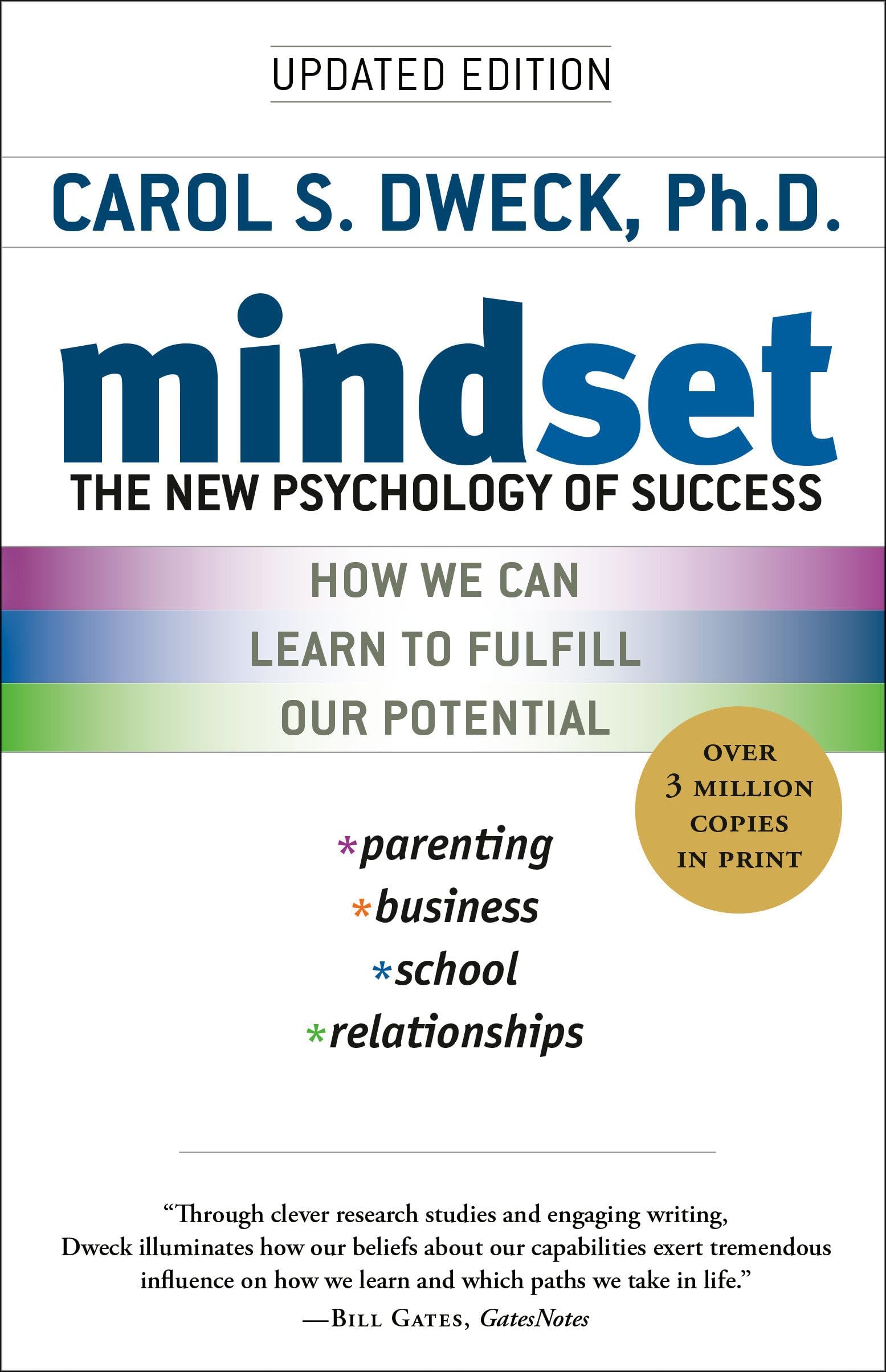
Mindset: The New Psychology of Success
Product ID: 286387
⭐4.6/5 from 23,243 reviews
📈Top 20 in Psychology & Counseling
📚Bestseller status #957 overall
Buy anything from 5,000+ international stores. One checkout price. No surprise fees. Join 2M+ shoppers on Desertcart.
Desertcart purchases this item on your behalf and handles shipping, customs, and support to Vietnam.
🚀 Elevate your success mindset — because your potential is limitless!
Mindset: The New Psychology of Success by Carol S. Dweck is a bestselling, research-driven book that explores the transformative power of adopting a growth mindset over a fixed mindset. With a 4.6-star rating from over 23,000 readers, it offers practical insights and inspiring case studies to help professionals and lifelong learners overcome challenges, embrace feedback, and unlock their full potential.


| Best Sellers Rank | #1,141 in Books ( See Top 100 in Books ) #10 in Personal Finance (Books) #22 in Psychology & Counseling #161 in Self-Help (Books) |
| Customer Reviews | 4.6 out of 5 stars 23,446 Reviews |
N**S
Life-changing
Mindset is another book in the seemingly endless production line of self help Psychology books available. Amazon recommended it to me based on my past purchases, and I decided to give it a try. I can honestly say that this book was eye opening for me. It’s based on the premise that there are two mindsets present in all human beings: The Fixed Mindset and The Growth Mindset. People with the fixed mindset, according to the author, are people who would rather not challenge themselves because it may reveal to them any inadequacy or weakness in their skill level or knowledge base. Conversely, people who possess the growth mindset are people who, regardless if they fail, crave the opportunity to better themselves even if it means admitting that they do not know as much as they thought they did in a particular subject or discipline. The author also dispels the myth of intelligence and natural talent, bringing to light the evidence-based realization that intelligence can be nurtured and cultivated through study and constant, unremitting learning. One’s learning ability, or intelligence, much like the brain itself, is indeed malleable. Fascinating stuff. By the way, another book in the same vein as this one is “Talent is Overrated” by Geoff Colvin. I may have reviewed it a year or two ago – I will have to check the archives of my blog. Halfway through the book I realized that I possessed traits and elements from both the fixed mindset and the growth mindset. I’m a lifelong learner, there’s no question about that. I’m ridiculed by most of my peers and friends for always reading and trying to learn more, but it’s who I am and who I've always been, unbeknownst to some. That being said, however, I can remember many times in my life when I was afraid to challenge myself because I felt like it would reveal weaknesses in my knowledge or skill. When I was younger, I used to abhor criticism; I felt like if someone criticized me it was a direct attack on who I was, so I’d respond by becoming defensive. Granted, most people will criticize you just to make themselves feel better or to put you down because they see you’re actually trying to do something; but if someone is more skilled than you are in something and he or she offers some constructive criticism, you should pay attention because that’s an invaluable tool for growth. I've learned that over the years without question. When I first started studying Karate (I was probably 11 or 12 years old), I was so full of passion for it. I used to go to my classes with a zest and zeal that rivaled the most enthusiastic of students, but I quickly realized, even though I thought I was a natural, that I had a lot of work to do before I could even consider myself a real student of the martial arts. At first I refused to accept that I wasn't as strong or as fast as I thought I was. I was stuck in the fixed mindset. I knew I was good at throwing kicks and punches because I taught myself how to fight. I didn't want to hear anything anyone else had to say. Eventually I learned the hard way that I would have to acquiesce to the instruction of my teachers, but the fixed mindset plagued me for many more years. It wasn't until I met my Jujitsu instructor about 5-6 years ago that I finally broke the fixed mindset outlook when it came to the martial arts. I was put on my back, painfully, over and over again by my instructor and learned, seemingly for the first time, about “emptying my cup” as the saying goes. I had to unlearn about 15 years of martial arts training and absorb, as a beginner, the teachings of my Jujitsu instructor. Let’s just say ice became my best friend. My fixed mindset even found its way into my guitar studies. I was always a decent guitar player, I guess, but I didn't start growing as a guitarist until I met someone who shattered my view of my skill level while working at my last job. This guy was the most skilled guitarist I had ever met, and I was humbled by his expertise. I’m still no way near his level of guitar playing, but because of the little time I spent with him I am a much better guitarist than before I met him. It was after meeting this person that I decided to start playing with people who were substantially better than I was. I sought out guitarists all over the place and asked to learn from them. I’d walk around Union Square in the city listening to the other musicians; I'd pay real attention to what they were playing and how they were playing it. I’d walk up to a few guitarists who I thought played beautifully and pick their brains. Some were eager to teach and some didn't want to be bothered. All in all, I became good friends with two of the guitarists I met. They still reach out to me and teach me technique and theory, and, when I can, I continue my own independent music study. Growth mindset in action. I've been sending a lot of my short fiction to professional, established writer friends of mine so that they can criticize and guide me in the hopes that I can be a better writer. A few weeks ago I sent one of my short stories to a writer I work with, and I asked him to be brutal. He read my story and sent me some feedback. I felt like when I was a little kid in school and one of my teachers gave me back one of my writing assignments adorned with her red markings. "Redundant!" "Comma here!" "Be more concise!" "Verb-subject agreement!" Good times. Anyway, my colleague gave me some useful advice and I immediately incorporated his suggestions into some of the stories I've already written. Consequently, I have also asked my uncle, who is an award-winning apologetics writer, to advise me and critique my writing. He’s been generous with his time and constructive with his advice. I will keep badgering him with grammar and syntax questions until he disowns me. It’s a price I’m willing to pay. So, back to the book. There is a lot of truth in this book, and I’m probably going to read it again soon. At the end of the book there is a chart that outlines the fixed mindset pathway of thinking versus the growth mindset pathway of thinking. It briefly outlines what someone with each mindset would do, or how they would think, given a circumstance. I have printed this chart out and I keep it hanging on my wall in my room so that I can look at it every day. I still have some fixed mindset elements that seem to permeate my thinking, but I’m more cognizant about them now. I’m working toward becoming a fully growth mindset focused person. I’m a work in progress, like most people, so bear with me. There are a lot of case studies of some great people in this book – Famous athletes, Actors, Politicians, Musicians, Teachers, Coaches – and each case study lends more credence to the author’s message: The Growth Mindset will help you achieve whatever it is you want to achieve. It’s a great book, and I recommend it to anyone struggling with honing his or her skills in anything. The author discusses how the fixed mindset and growth mindset is evident in every facet of life. Whether it is in parenting – how some parents instill a belief in their children that they are geniuses, and these children refuse to grow because they think there is no more growing to be done – or in our professional lives - how to learn from and adapt to unethical and dishonest colleagues (something I live with).
R**R
Go for the Gold: Grow the Mind of a Champion
Make it happen! There are 8 months until the Winter Olympics that will begin Feb. 7th, 2014. Now is a good time to coach your children about the meaning of "success", "champion" and the "agony of defeat." Throughout the games we'll hear inspirational stories about athletes that work hard, meet challenges head on, and learn from past mistakes. "Mindset"appears to be a classic within teaching and psychology circles. This easy-to-read book, will guide you in coaching your children to have a growth mindset, rather than a fixed mindset, that will help them achieve success, jump over hurdles, and think like a champion. In order to benefit from "Mindset", you're going to first have to take a cold, hard look at your parenting skills. Have you ever said or thought, "My child is a natural athlete, or artist, or genious"? Shockingly, Dweck's research shows that such statements can provoke a fixed mindset, harming motivation and performance because of the implication that failure means you're not talented or you're dumb. She notes "...one thing leads to another - how a belief that your qualities are carved in stone leads to a host of thoughts and actions and how a belief that you can cultivate your qualities leads to a host of different thoughts and actions, taking you down an entirely different road." Dweck doesn't stop with just one or two convicting examples. She assails you with an onslaught of examples, one after another, to prove her point. Her illustrations cover everything from sports, to school, to business. She builds a strong case that certain "natural" athletes, such as John McEnroe, demonstrated a fixed mindset that prevented them from facing failure with grace and fortitude. McEnroe was notorious for tantrums on the court when he was near defeat. And, he gushed excuses for every setback-hardly what anyone would call a "good sport". A fixed mindset also explains why the obsession in hiring "talent", by execs such as Lay and Skilling, of ethically-challenged Enron, resulted in the downfall of an entire conglomerate. At critical decision points they "blamed others, covered mistakes, and pumped up stock prices...". Whereas athletes such as Michal Jordan and Pete Sampras and business leaders such as Jack Welch, accomplished GE CEO, all had growth mindsets, shown by the way they overcame difficulties, worked hard, and championed to great success. Their egos were always in check, which kept them in touch with reality and their humanity. Time and again, Dweck demonstrates that skills and achievement come from commitment and effort, not from natural smarts or physical attributes. Over and over, Dweck emphasizes the growth mindset that is notable in champions such as Wilma Rudolph, First American woman Runner to win three gold medals at a single Olympics. According to Wilma, "My mom taught me very early to believe I could achieve any accomplishment I wanted to. The first was to walk without braces." This growth mindset belief, instilled by her mother, cultivated Wilma's ability to walk. Her step-by-step determination and discipline, catapulted Wilma, at age 12, to defeat paralysis in her leg, shed the brace, become a champion and work her way towards becoming an Olympian. But what can you do if you're a fixed-mindset-pushing-for-over-a-decade parent? Dweck explains that everyone can teach and encourage a growth mindset. In fact, with training, Dweck says that success can be achieved in all facets of life, including education, sports, relationships, and careers. Dweck gives a number of practical exercises to help anyone train others in her methodology and work through to growth-minded solutions. From these models, instead of saying "you're a genious", you'll learn to say "see what you can achieve when you work hard". Dweck makes it clear that her paradigm does not include preferences and that change is not easy. She says that, in relationships, individuals "have to actually want to change, commit to change and take action to change." She concedes that maintaining a growth mindset "takes plenty of time, effort, and mutual support." Before the Olympics begin, make-up your mind to read "Mindset", and start training your children to grow their minds and go for the gold... Make it happen!
L**T
Unlock Your Potential with "Mindset: The New Psychology of Success"
"Mindset: The New Psychology of Success" by Carol S. Dweck is a thought-provoking and insightful book that challenges our beliefs about talent, intelligence, and personal growth. Dweck introduces the concept of a fixed mindset versus a growth mindset, and explores how our mindset influences our achievements, relationships, and overall success. In this review, we will delve into the key ideas presented in "Mindset" and how it can positively impact your life. One of the book's greatest strengths is its ability to transform the way we perceive ourselves and our abilities. Dweck emphasizes that our mindset—whether fixed or growth—determines our response to challenges, setbacks, and even criticism. By embracing a growth mindset, which focuses on the belief that our abilities can be developed through dedication and hard work, we open ourselves up to greater possibilities for personal and professional growth. Dweck highlights the importance of effort and learning as key components of achieving success. She provides numerous examples of individuals who, through their perseverance and willingness to embrace challenges, have reached remarkable heights. By embracing a growth mindset, we become more motivated to put in the necessary effort, learn from failures, and continuously improve ourselves. This shift in mindset enables us to see setbacks as opportunities for growth rather than personal failures. The book also sheds light on the impact of mindset on our relationships with others. Dweck explores how a growth mindset fosters healthier interactions and collaborations by emphasizing the value of learning, constructive feedback, and supporting others' development. By understanding that our abilities can be developed and improved, we become more open to helping others succeed and seeing their successes as inspirations rather than threats. "Mindset" not only provides valuable insights into the power of mindset but also offers practical strategies for cultivating a growth-oriented mindset. Dweck shares actionable advice for parents, educators, coaches, and individuals seeking personal development. The book's relatable examples and research-based approach make it accessible and applicable to various areas of life, from education to business and beyond. "Mindset: The New Psychology of Success" is a captivating exploration of the impact of our mindset on our achievements and personal growth. Carol S. Dweck's work challenges conventional thinking, inspiring readers to adopt a growth mindset and unleash their full potential. By embracing the principles outlined in this book, you can transform your approach to challenges, relationships, and personal development. "Mindset" is a must-read for anyone seeking to achieve greater success and fulfillment in life.
S**M
A Powerful Reminder That Growth Starts with How You Think
Mindset was a really meaningful read for me, and it changed the way I look at challenges and personal growth. The core idea — the difference between a fixed mindset and a growth mindset — sounds simple at first, but the more you read, the more you realize how often these patterns show up in everyday life. What I liked most is how the book breaks down how our beliefs about ability and talent can either hold us back or push us forward. It made me think about times where I avoided challenges or got frustrated too quickly, and how much of that came from thinking “I’m just not good at this.” The book does a great job showing that with effort, learning, and perseverance, you can grow far beyond where you started. The examples from sports, business, education, and parenting help drive the point home in a way that’s easy to connect to your own life. I also appreciated how the book shows that a growth mindset isn’t about being positive all the time — it’s about embracing the process and being willing to learn from mistakes instead of seeing them as proof of failure. If there’s one drawback, it’s that some sections can feel repetitive, especially once the main concept is established. But even with that, the message is strong enough that the repetition helps reinforce it. Overall, Mindset is a powerful and eye-opening book that makes you more aware of your own habits and beliefs. If you want to improve how you approach challenges, goals, and personal growth, this is definitely a book worth reading.
G**Z
Good Medicine But Hard To Swallow
For several months now I've been enjoying and at the same time agonizing over the book, MINDSET, The New Psychology of Success, by Carol S. Dweck, PH.D., a Professor of Psychology at Stanford University. The book presents the results of over 20 years of research into the question of why some experience more success than others. "For 20 years, my research has shown that the view you adopt for yourself profoundly affects the way you lead your life. It can determine whether you become the person you want to be and whether you accomplish the things you value." The views she is talking about are our old friends, nature versus nurture, genes versus environment, I.Q. versus effort. She doesn't really get into the the issue of whether some people are naturally more intelligent or talented than others, that's all besides the point. What her research shows is that people with a fixed mindset, i.e. they believe that their intelligence, creativity, abilities and talents are fixed and cannot be increased, cannot be grown, tend to be less successful than people with a growth mindset, who believe that their intelligence, creativity etc. can be developed. The interesting thing is that it doesn't matter if your fixed mindset is high or low, that is if you're a positive thinker or a negative thinker; either way a fixed mindset will impeded your success. The book is filled with examples of the two types from the world of sports and business and sketches of her tests of the theory with elementary school children and college students. After thinking about it for several months, here's my take on what Prof. Dweck has discovered. The definition of success for a person with a growth mindset is growth and improvement. Have I improved? Am I doing better today than yesterday? These are the questions a person with a growth mindset uses to evaluate performance. If I have improved then I am succeeding. If I have not improved then I need to change the way I'm studying, or practicing or preparing so I can be more successful. On the other hand a person with a fixed mindset asks, What is my I.Q.? Am I smarter than the others? Am I better than everyone else? Am I worse than everyone else? Am I talented or untalented? Do I have musical abiilty or not? Do I have the talent to be a writer or do I not? I think that being discovered is one definition of fixed mindset success. If the fixed mindset person's talent hasn't been discovered he concludes that it's because he is not talented, or people are against him or no one will help him. The growth mindset person sees the trophy, the medal, the promotion, as a mere byproduct of the growth that he has experienced. For the fixed mindset person the trophy, the medal, the promotion, is the point, they are the outward manifestations of his inward superiority. The irony is that the fixed mindset person ends up sabotaging himself because his fixed mindset world view also makes it difficult for him to take risks, or to develop his abilities, in other words, to grow. The fixed mindset person doesn't, after all, believe in growth. As a result fixed mindset people become quite frustrated. Prof. Dweck's studies give a scientific basis for something that Coach Wooden, of UCLA Basketball fame, discovered long ago: Focus on effort not winning. The factors which determine whether you will win or loose are not all within your control, but the effort you put in to developing and executing your game is. I don't believe that I can overstate the importance of this book. I've been reading self help, positive thinking, motivational books since at 10 years of age I picked up a Norman Vincent Peale book that my mom had checked out of the library. Those books, all good, are trying to deal with the problem by attacking the fruit of an individuals mindset. Prof. Dweck is attacking the problem at the root. This book was for me a very uncomfortable read and forced me to analyze my own mindset and much to the chagrin of this basically fixed mindset person I've discovered that I am in many areas a fixed mindset person. OUCH! But what's worse is realizing that many of the things which I have said and done, thinking I was encouraging others and building them up to achieve success, were in fact helping them to fail. OUCH! OUCH! Well the good news is that you can change your mindset. Greg Marquez [email protected]
A**L
Fantastic Book! Get ready to be blown away!
This book completely shifted my perspective in several areas of life. Carol Dweck brings years of powerful research together in a way that’s both eye-opening and actionable. Highly recommended for anyone serious about personal growth.
T**Y
This book is like panning for gold... there’s a lot of effort required for a few nuggets of gold.
I bought this book to help my daughter. She has quite a serious issue with fixed mindset, so I got the kindle version, which I now realise was a mistake. You see a kindle has this little tracker at the bottom of each page telling you how far through the book in terms of %. I was so determined to help my daughter that I sat down and read the first 25% in a single sitting. The supporting material was great, I’d read about what fixed mindset looks like, why people think like they do, and why it’s a problem. The next day I read the next 25%, lots more supporting information, and some examples about how this stuff can profoundly affect people’s growth, and how overcoming it can be profoundly life changing. Great! Next 25% of the book more of the same, but I figure you know maybe it’s just me, maybe some people take longer to understand the ramifications. Then at about 76%, the book talks about a “brainology class” used across 20 schools and how amazing the results have been... finally I think to myself we’re getting to the payoff.... “obviously this brainology or mindset workshop was performed with a large staff and isn’t easy to replicate at scale” ... ok I get that, but you’ve come up with a way to adapt this workshop, right? Two pages later... “the rest of this book will be about you!” Wait... what? By the fact that I picked up this book shows that either I already have a growth mindset and I’m looking to make it better, or I have a fixed mindset, but am looking to improve (also indicating that I’m aware of what needs fixing and want to grow)... so telling me to look at fixed mindset situations differently is great.... but how do I teach a child with a fixed mindset, that doesn’t realise they have a problem to change their thinking? It’s already been highlighted extensively in the book that people that don’t realise they have a fixed mindset, are unlikely to understand and appreciate the changes they need to make. How many psychologists does it take to change a lightbulb? Only one, but the lightbulb has to “want” to change first! So, if you’re one of those people that is aware they have a problem, know you need to change it, and are ready for the change, then this will be a great help (once you get past the first 75% of the book). There is a part of the book that helps you guide your children to a growth mindset (between about 79% and 82%), and I’m super thankful for those pages, and will implement them with excitement and optimism, after that it slides back into having the reader think about things differently and focus on internal mindsets and self-help. Then there’s a summary about how to progress your self-help and maintain your growth mindset. The book is done at about 85% and the rest is notes, bibliographical references, and other appendices. So I guess in summary, if we look at the sum total of the book (as 100%). 79% is supporting material, setting the scene; 6% is guidance (79% to 85%) and the remaining 15% is the usual supplementary material found at the end of non-fiction books. Perhaps I’m being too hard here, I may have missed some real gold nuggets here, but I really started to struggle at 70%. The book is solid and really helps you see fixed mindset for the damaging thing that it is (let’s face it if you don’t understand it after 75% of the book, then maybe you need to work harder at it) and really helps you see the trait in others, but ultimately I was overwhelmed with background, and underwhelmed with the self-help aspect.
A**A
Masterful description of how to Learn
This is an outstanding book that offers a powerful model of how to think about learning and growing. Your beliefs about the human qualities of intelligence, social skills, likability, adaptability, etc., will determine how you evaluate situations and then respond to those situations. If you believe that these qualities are fixed, like traits, you will develop a personal style that guards and protects this precious quantity while secretly worrying that you might have not been given enough of this endowment to make you above average, special. Conversely, believing that people are given different endowments at birth but with effort, practice, and diligence you can accomplish goals that initially seemed impossible by growing and developing your capabilities you are not deterred by a fear of failure. The central idea is this: are you a 'learner' - someone who thrives and looks for challenges believing that over time difficult situations become easier and that not following your dreams because you're afraid you might fail is the most unfortunate choice a person can make in their life or are you a 'non-learner' - someone who seeks success & validation, feels good when praised and preoccupied with being competent but secretly wishing you would take a big risk, accept a new challenge, or embrace going in a new direction with your life. If this seems interesting to you please get this book. It's worth your time to see if this book can help you. Authors must confront the challenge of deciding which audience they wish to address with their book. With this book, Mindset, the author has a long and established academic career so she is attempting to present her ideas to a more general audience. If you think the book lacks a more academic treatment of the subject a simple search on Google scholar will provide many academic articles with a more systemic approach to the subject. You don't become a tenured Prof. at Columbia and then Stanford unless you are a prolific publisher of novel research in top journals. The book does often repeat ideas that were already addressed earlier in the book. This is instructive and necessary. The main idea of the book seems straight forward but it is subtly complex. Reintroducing the ideas allows the reader to get the finer details in different settings. While the model might seem simple and the description of the two mindsets easy to understand it is considerably more complicated and some may wish to resist seeing themselves as different that who they think they really are. This offers the reader many examples in different settings so that a clearer understanding can develop. Also, change is hard. You are literally rewiring your brain. You are consciously avoiding indulging old thought patterns to forge new neuronal connections. The old patterns will not disappear, you create the option of choosing a different path which will become more ingrained with greater use. It is encouraging to read about others who have made significant changes in their life. Even if you find that you have a growth mindset you are likely to still have some fixed tendencies and you will surely have to deal with others that have fixed mindsets so this book is for everyone.
M**A
Great book full of growth/fixed mindset examples
I think the book was really good explaining when the growth/fixed mindset appears on people. It was great how the book explained the different mindsets in every possible way: business, sports, education, childhood... every person can benefit from the different stories. At the end it was addressed how to be more aware of the fixed mindset, I would love to have more tips on how to overcome the fixed mindset. Recommended for everyone
F**X
Absolut lebensverändernd! Ein Muss für jeden, der wachsen möchte.
Ich habe "Mindset: The New Psychology of Success" (im Deutschen oft als "Mindset: Wie Sie Ihr Denken verändern und Ihr Potenzial entfalten" bekannt) von Carol Dweck gelesen, und ich kann mit voller Überzeugung sagen, dass es eines der prägendsten Bücher ist, die ich je in den Händen hatte. Dieses Buch ist kein einfacher Ratgeber, sondern ein tiefgründiges Werk, das unser Verständnis von Erfolg, Lernen und persönlicher Entwicklung auf den Kopf stellt. Dweck präsentiert darin ihre bahnbrechende Forschung zu den Konzepten des "Fixed Mindset" (starres Denken) und des "Growth Mindset" (Wachstumsdenken). Sie erklärt überzeugend, wie diese grundlegenden Überzeugungen über unsere Fähigkeiten und Intelligenz unser gesamtes Leben beeinflussen – von unseren Beziehungen über unsere Karriere bis hin zu unserer Erziehung und unserem Umgang mit Herausforderungen. Besonders beeindruckend fand ich: Die Klarheit und Zugänglichkeit: Dweck schafft es, komplexe psychologische Konzepte auf eine verständliche und nachvollziehbare Weise zu vermitteln. Keine Spur von trockenem Universitäts-Jargon! Die Fülle an Beispielen: Ob aus dem Sport, der Wirtschaft, der Kunst oder dem Elternhaus – die zahlreichen Fallstudien und Anekdoten illustrieren die Theorie perfekt und machen das Buch lebendig. Man erkennt sich oder Menschen aus seinem Umfeld immer wieder in den Beschreibungen. Das war echt ein Augenöffner. Die praktische Anwendbarkeit: Das Buch gibt nicht nur Einblicke, sondern auch konkrete Ansätze, wie man ein Wachstumsdenken entwickeln und fördern kann, sowohl bei sich selbst als auch bei anderen. Das ist besonders wertvoll für Eltern und Lehrende. Die hoffnungsvolle Botschaft: Die Quintessenz, dass wir unsere Fähigkeiten und Intelligenz durch Anstrengung und Hingabe entwickeln können, ist unglaublich ermutigend und befreiend. Es nimmt den Druck des Perfektionismus und öffnet Türen für kontinuierliches Lernen und Verbesserung. Ich habe das Buch bereits mehrfach verschenkt und empfehle es jedem, der: Sich persönlich weiterentwickeln möchte. Herausforderungen nicht als Sackgasse, sondern als Chance sehen will. Eltern oder Pädagoge ist und Kinder zu widerstandsfähigen und lernfreudigen Menschen erziehen möchte. Verantwortung für Teams oder Mitarbeiter trägt und deren Potenzial voll ausschöpfen will. Kurz gesagt: "Mindset" ist ein Game-Changer. Es hat meine Sichtweise auf Erfolg und Misserfolg grundlegend verändert und mir geholfen, mein eigenes Potenzial besser zu erkennen und zu nutzen. Absolute Leseempfehlung!
J**N
Mindset is belangrijk
Een vlot geschreven boek die je wegwijs maakt in de wereld van mindset
A**R
Mindset
Great insights are written. I have just started reading it but I could recommend it to anyone who is looking for life detour inorder to live a meaning and purposeful life!
D**D
Parfait
C'est un livre absolument génial, que vous soyez familier du concept ou que vous découvrez totalement le principe du mindset de croissance il est à lire :)
Trustpilot
5 days ago
1 day ago